What is a Holistic Progress Card? The Complete Guide for Indian Schools 2026
If you lead a school in India in 2026, you have almost certainly been asked the same question by a parent, a board inspector, or a curious teacher: "So what exactly is this Holistic Progress Card we keep hearing about?"
The short answer is that the Holistic Progress Card (HPC) is the 360-degree, competency-based replacement for the traditional marks-only report card — designed under NEP 2020, operationalised by NCERT's PARAKH unit, and now actively being rolled out by CBSE and state boards.
The longer answer — what HPC actually contains, how it differs from a co-scholastic grade, what it demands of teachers, and how schools can adopt it without drowning in paperwork — is what this guide is for.
By the end of this post, you will know exactly what an HPC is, where it came from, what it must contain, and what a realistic 2026 implementation roadmap looks like for a CBSE, ICSE, or state-board school in India.
1. What is a Holistic Progress Card? A clear definition
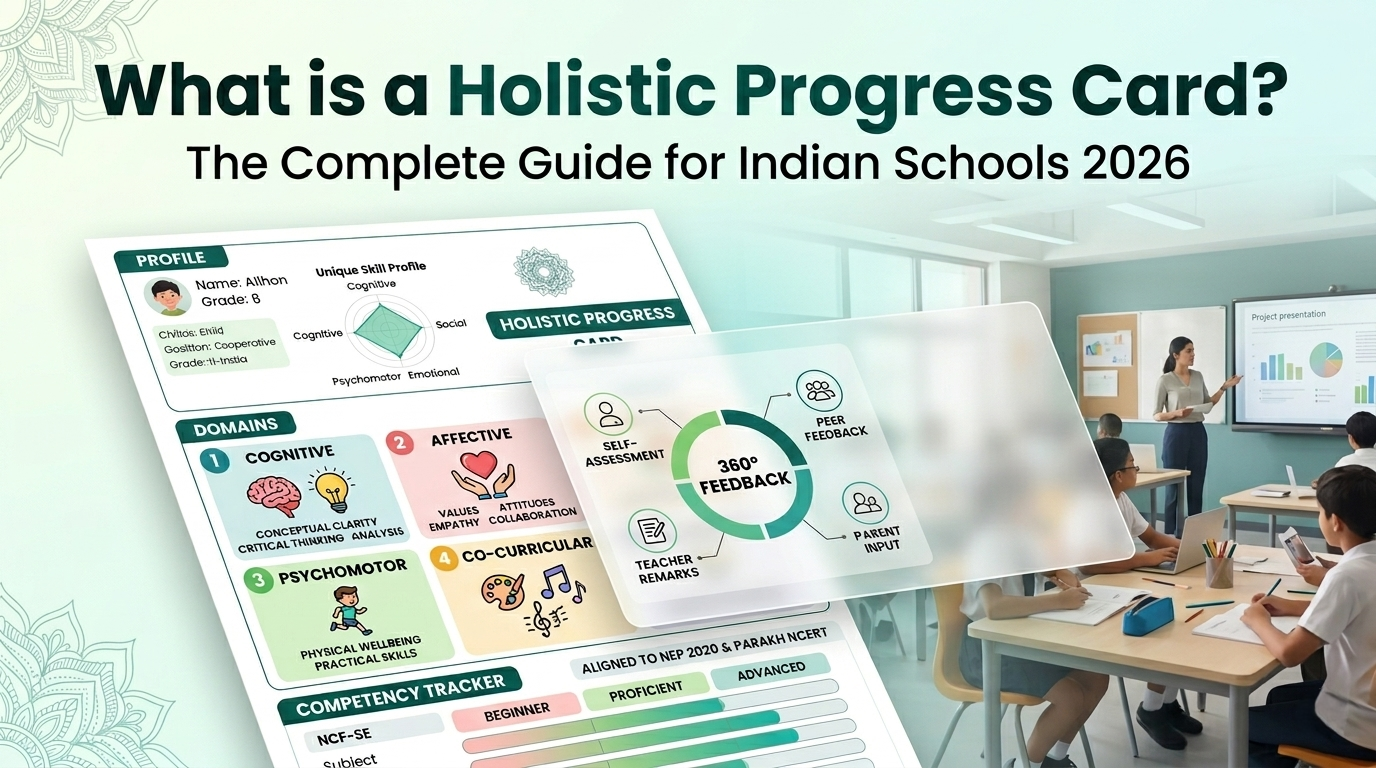
A Holistic Progress Card is an individualised, evidence-based record of a child's growth across cognitive, socio-emotional, physical, creative, and ethical domains — reported using competency descriptors and qualitative feedback rather than only marks.
NCERT and PARAKH define it as a 360-degree progress card developed to aid assessment of competency-based learning and teaching by making student assessment more comprehensive and holistic.
In plain language, an HPC answers four questions a traditional report card cannot:
What can this child do with what they know — not just what they can recall in an exam?
How is this child growing across academics, life skills, arts, sports, and values?
What do the teacher, parent, peers, and the child themselves observe about that growth?
What should the school and family do next to support this child?
It is both a pedagogical tool (it shapes how teachers plan and observe) and a reporting tool (it replaces the term-end report card).
2. Why HPC exists: the NEP 2020 and NCF 2023 backdrop
Three policy documents drive the HPC mandate in India:
National Education Policy (NEP) 2020 — Section 4.6 explicitly calls for a shift away from rote-driven, high-stakes exams toward regular, formative, competency-based assessment. NEP envisions the progress card as a holistic, 360-degree, multi-dimensional report capturing each learner's uniqueness across cognitive, affective, and psychomotor domains, including self and peer assessment.
National Curriculum Framework for School Education (NCF-SE) 2023 — operationalises NEP's assessment vision inside the new 5+3+3+4 stage structure (Foundational, Preparatory, Middle, Secondary), giving non-academic domains — sports, arts, values, life skills — equal weight to subject learning.
PARAKH (Performance Assessment, Review, and Analysis of Knowledge for Holistic Development) — the assessment unit established within NCERT, mandated to design and disseminate stage-wise HPC templates and competency rubrics for schools across India.
By December 2023, CBSE issued Notification 82 adopting PARAKH's HPC prototypes for the Foundational Stage and asked affiliated schools to begin transition. State SCERTs (including Chandigarh, Ladakh, and others) have followed with their own HPC fill-up manuals and orientation programmes for the Middle Stage.
The direction is unambiguous: HPC is not optional guidance. It is the policy default for Indian school assessment going forward.
3. How HPC is different from a traditional report card
The differences are not cosmetic. HPC re-engineers what a school measures, who measures it, and how the result is communicated.
Dimension | Traditional Report Card | Holistic Progress Card |
|---|---|---|
What it measures | Subject marks, exam grades | Competencies across cognitive, socio-emotional, physical, creative, and ethical domains |
How it's reported | Numerical marks, percentages, ranks | Qualitative descriptors and rubric levels (e.g., emerging, meeting, exceeding) |
Evidence base | One or two summative exams per term | Continuous portfolio: classwork, projects, observations, performance tasks |
Whose voice does it carry | Teacher only | Teacher + parent + peer + self-reflection |
Co-curricular treatment | A single grade or remark line | Specific indicators across activities, skills, and values |
Use after issue | Filed away until next term | Anchors a structured parent-teacher conversation and the next learning plan |
The most consequential shift is from summative judgement to formative dialogue. An HPC is not a verdict on the child; it is the next chapter in a multi-year developmental story.
4. What goes inside an HPC: the NCERT/PARAKH architecture
While the exact layout varies by stage, the official PARAKH templates share a consistent structural backbone. Schools building or evaluating an HPC format in 2026 should expect to see all of the following:
Learner profile — name, photograph, demographics, language background, and, where relevant, learning needs.
Developmental goals — at the foundational stage, organised around three broad goals: health and well-being, effective communication, and involvement in learning. Each goal expands into specific competencies.
Competency-based rubrics — visual metaphors (PARAKH uses Stream–Mountain–Sky) representing performance levels. Teachers mark the level supported by the evidence they have collected.
Section-wise narrative feedback — short, specific written comments per domain on strengths, areas for support, and suggested next steps.
Self, peer, and parent reflections — dedicated spaces for the child's own reflection, peer observations, and parent inputs and commitments.
Attendance, health, and participation indicators — basic contextual data, especially in state versions.
Summary dashboard — a one-page overview families can read at a glance.
At the Preparatory, Middle, and Secondary stages, the same skeleton extends into subject-wise competencies, cross-curricular skills, project work, and — at the secondary stage — career-readiness indicators.
5. The domains that an HPC actually covers
The specific indicator banks differ by stage and by school, but eight domain families recur consistently across NCERT prototypes and credible early implementations:
Scholastic learning — subject-wise understanding, application, reasoning, problem-solving.
Foundational literacy and numeracy (FLN) — reading fluency, comprehension, writing, number sense, mathematical thinking.
Cognitive and higher-order skills — critical thinking, creativity, inquiry, decision-making.
Socio-emotional skills — self-awareness, self-management, empathy, collaboration, resilience.
Life skills and values — responsibility, leadership, ethics, citizenship, environmental consciousness.
Physical development and health — gross and fine motor skills, stamina, sports participation, health habits.
Arts and creativity — visual arts, music, dance, theatre, creative expression.
Co-curricular engagement — clubs, competitions, community service, and school events.
This last domain — co-curricular engagement — is where most schools struggle the hardest to produce defensible, comparable data. We will return to it in Section 9.
6. Where the evidence comes from
An HPC is only as credible as the evidence behind each rubric mark. NEP and NCF stress that assessment should be classroom-embedded, varied in method, and accumulated over time. Recognised evidence sources include:
Classroom observations and anecdotal records.
Portfolios of student work — notebooks, projects, digital artefacts.
Performance tasks, projects, and inquiry-based activities.
Quizzes and worksheets designed to probe competencies, not memorisation.
Self-assessment and peer-assessment reflections.
For older grades, board-mandated marks or grades, layered with qualitative feedback.
State HPC manuals are explicit that foundational-stage HPCs should not carry scores or grades. Teachers describe progress; they do not rank.
7. New roles for teachers, students, and parents
HPC asks every stakeholder to behave a little differently from how the marks-and-ranks system trained them.
Teachers become observers and learning coaches — collecting evidence over weeks, applying rubrics consistently across children, and facilitating reflective conversations.
Students are expected to self-assess — set personal goals, curate their own portfolio, and articulate where they want to grow.
Parents shift from reading a verdict to participating in a partnership — using the HPC as a diagnostic, not a judgement.
NEP explicitly mandates that HPCs be accompanied by structured parent-teacher meetings, not handed over silently at term end. The conversation around the card is the point.
8. Adoption status across Indian schools in 2026
Adoption is not uniform — but momentum is unmistakable.
Government and SCERT-led systems — Foundational-stage HPCs are being piloted across multiple states, with standardised templates and teacher training.
CBSE-affiliated schools — Following Notification 82 (Dec 2023), CBSE schools have begun adopting foundational HPC formats and integrating them with FLN and competency-based initiatives.
Private schools (urban and affordable) — Many have started designing their own "holistic report cards" inspired by NEP language. Quality and fidelity vary widely; some are genuine, some are cosmetic.
IB and Cambridge schools in India — Already use portfolio-based, criterion-referenced reporting and are mapping NEP language onto existing systems rather than wholesale-adopting Indian templates.
PARAKH's Rashtriya Sarvekshan 2024 — a national competency assessment of Grades 3, 6, and 9 across 75,000+ schools and 22 lakh students — is reinforcing the broader competency-based assessment culture HPC depends on.
9. Why most schools struggle: the five real implementation challenges
Despite strong policy backing, principals consistently report the same five obstacles when moving from a traditional report card to a genuine HPC:
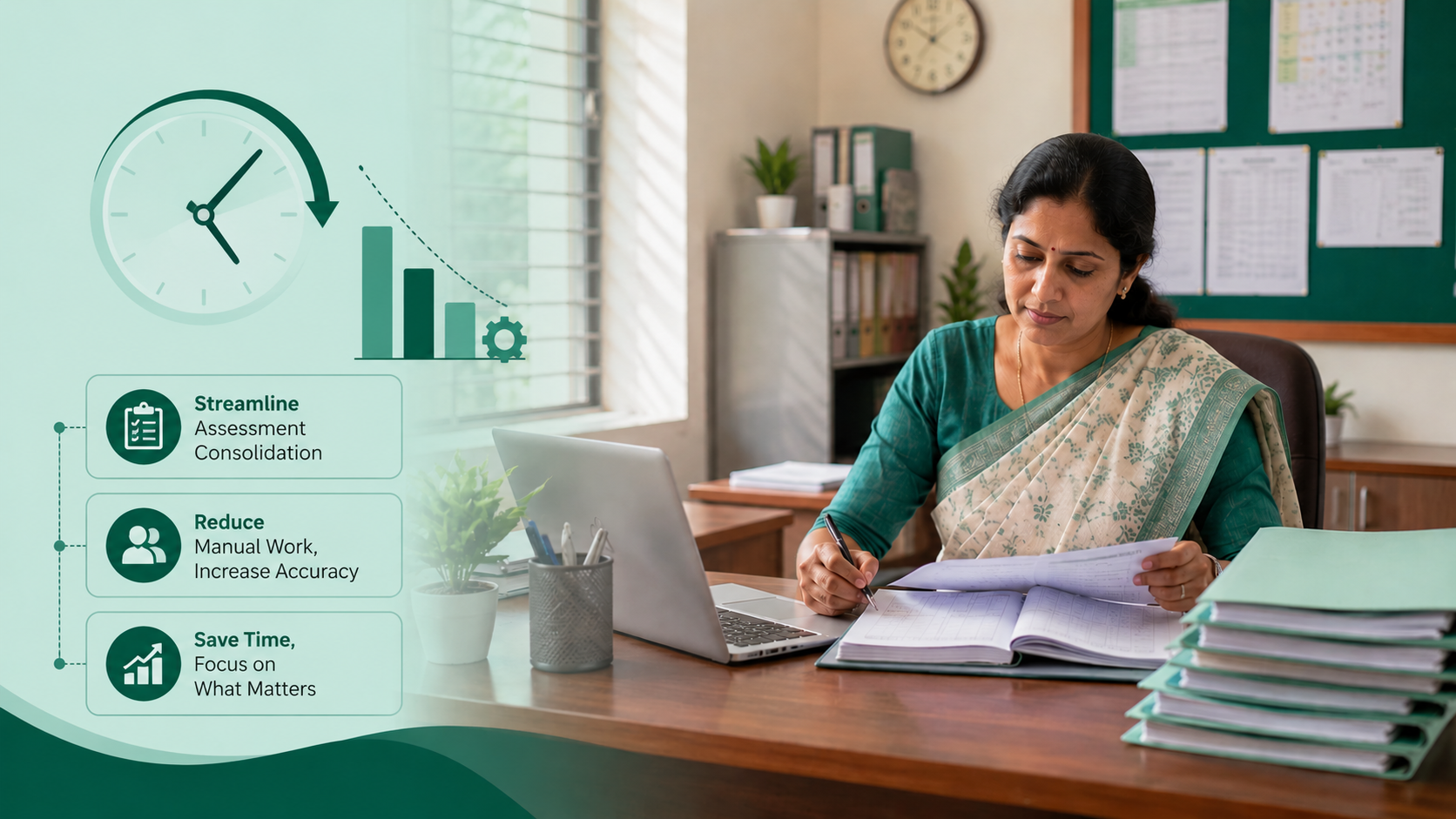
Teacher workload — designing tasks, collecting evidence, and maintaining portfolios for 30–40 children per class is time-intensive, especially with high pupil-teacher ratios.
Rubric design and consistency — translating broad competencies into observable indicators that two different teachers will rate the same way is genuinely hard.
Data management — capturing, storing, and visualising multi-dimensional assessment data across years is impossible on spreadsheets at any reasonable scale.
Change management — many parents and senior teachers are emotionally anchored to marks and ranks; shifting that mindset takes sustained communication.
Co-curricular measurement — most schools have no defensible methodology for scoring co-curricular development. Activities get a letter grade or a paragraph remark, not a structured score.
This last gap matters more than it looks. Co-curricular engagement is one of the eight HPC domains — and arguably the one most distinctive to NEP's holistic vision — yet it is the domain schools are least equipped to measure rigorously.
This is precisely the gap Reportify's Co-curricular Skill Development (CSD) framework was built to close. Designed at IIM Lucknow and grounded in NEP 2020 and NCF 2023, the framework maps 619 co-curricular events across 6 categories and 68 sub-categories to 12 skill domains, then computes a transparent CSD Score on a 0–5 scale using five independent dimensions: Skill Relevance, Participation Volume, Achievement, Temporal Consistency, and Competition Intensity. A meaningful demonstration: 5–6 intra-school events across different categories can move a student to a CSD Score of 4.5 or higher — meaning a school with no national-level access can still show strong holistic development. You can try the CSD engine for free — no login, no email — and see a live score against any sample participation record.
10. A practical 2026 implementation roadmap
Schools that treat HPC as an iterative change project — not a one-shot compliance exercise — see far smoother transitions. A realistic eight-step roadmap looks like this:
Orientation and buy-in — leadership, teacher, and parent workshops on NEP/NCF assessment reform and the purpose of HPC, not just the format.
Pilot in 1–2 grades — typically Foundational or Middle stage, with a limited set of competencies. Resist the urge to roll out school-wide in Year 1.
Adopt and adapt rubrics — start from PARAKH/NCERT templates; customise wording and exemplars to your school context without breaking the underlying framework.
Re-engineer classroom assessment — embed competency-aligned tasks, projects, and observation routines into your existing schemes of work.
Set up data systems — paper portfolios are fine for Year 1; by Year 2 you will need a digital backbone for evidence capture, scoring, and longitudinal tracking.
Run structured parent-teacher conversations — use even early HPC drafts to anchor real dialogue. Gather feedback on clarity and usefulness.
Review and refine — every term, audit teacher workload and rubric consistency. Trim what isn't working.
Scale across grades — once foundational practices are stable, expand to additional stages and domains.
11. The role of EdTech and ERPs in making HPC sustainable
You cannot run a serious HPC at scale on Excel. Once you have more than a few classes generating multi-source, longitudinal evidence, you need digital infrastructure that can:
Provide stage-wise HPC templates schools can configure to their own indicators and branding.
Maintain competency and indicator libraries pre-mapped to NEP, NCF, and PARAKH frameworks.
Capture evidence and portfolios — photos, videos, teacher notes — linked to specific competencies.
Offer multi-stakeholder interfaces for parent reflections, student self-assessment, and peer feedback.
Surface analytics and dashboards so principals can see class-wide and school-wide trends at a glance.
NEP itself anticipates this future, mentioning AI-based tools that use HPC data over multiple years to help students discover their strengths, interests, and possible career paths. In 2026 most platforms are still early-stage — but the direction of travel is clear, and the schools that build the data infrastructure now will compound that advantage every year.
12. A design checklist for your school's HPC
Whether you are designing from scratch or auditing an existing format, every credible 2026 HPC should pass this checklist:
Policy alignment — explicit mapping to NEP 2020, NCF-SE 2023, and PARAKH's stage-wise templates.
Clear developmental goals — broad goals with indicators that ladder up to them.
Balanced domains — meaningful space for scholastic, co-curricular, socio-emotional, and physical development. No tokenistic co-scholastic strip.
Competency-based indicators — behaviourally specific descriptors ("explains ideas clearly in group discussions") rather than vague traits ("good communicator").
Performance levels with exemplars — 3–4 levels per indicator, each illustrated with a concrete example of evidence.
Multi-source feedback — teacher, self, peer, and parent reflections, including goal-setting.
Child-friendly language and design — age-appropriate icons, plain language, growth-oriented (not deficit-oriented) wording.
Portfolio and evidence links — digital artefact links or paper portfolio references for every major rubric mark.
Attendance and health snapshot — basic indicators, where relevant.
Summary dashboard — a one-page overview a parent can read in two minutes.
If your current report card fails three or more of these tests, you are running a traditional card with a holistic label — not an HPC.
13. The outlook beyond 2026
Given the policy momentum and the early implementation evidence, Holistic Progress Cards are likely to become the dominant assessment and reporting paradigm across Indian schools over the next decade. As NCF-aligned textbooks and classroom practices roll out, HPCs will increasingly be rooted in day-to-day pedagogy rather than existing as separate compliance artefacts.
Expect three further developments over the rest of this decade:
Tighter integration between national assessments (Rashtriya Sarvekshan), school-level HPC data, and personalised learning analytics.
Domain-specific HPC variants for vocational, arts, and sports pathways at the Secondary stage.
Interoperability standards that let a student's progress profile move with them across schools and states.
For 2026, however, the task is more concrete: internalise the principles of the Holistic Progress Card and begin implementing them in a sustainable, context-sensitive way — starting with a pilot, a defensible rubric, and a real plan for the co-curricular evidence gap.
Bringing it all together
A Holistic Progress Card is not a new template you print at the end of the term. It is a re-engineering of what your school chooses to measure, who gets to speak into the record, and how that record is used to guide the next year of a child's learning.
The schools that get this right in 2026 will not be the ones with the fanciest format. They will be the ones who built the underlying evidence systems — competency rubrics that teachers actually use, portfolios that students actually own, and a way to score the co-curricular development that NEP demands but which most schools cannot yet measure.
If you would like to see what a defensible, NEP-aligned holistic record looks like end-to-end — academic results, co-curricular skill development, and a single Holistic Score on a 0–10 scale — Reportify is built for exactly this.
→ Try the Skill Analyser free — see the CSD framework score a real participation record live, with no login required. → See how schools implement Reportify — automated report cards plus the holistic layer your current ERP doesn't capture. → Book a demo — a 30-minute walkthrough tailored to your school's structure, board, and current report card system.
About this guide
Reportify is a holistic student development platform for Indian K-12 schools, incubated at the IIM Lucknow Enterprise Incubation Centre. The platform combines academic results and a co-curricular skill development score into a single Holistic Score, grounded in NEP 2020 and NCF 2023.