
Why Marks Alone Don't Measure Student Development — A Guide for Indian Schools
For two generations, an Indian student's worth has been compressed into a single number on a board mark sheet. That worked when education policy treated knowledge recall as the goal. It does not work for the system NEP 2020 describes, where holistic student development in India is the explicit objective and the 360-degree Holistic Progress Card is the proposed instrument. Principals and academic heads are now caught between two pressures: parents who still ask "what percentage did she score," and a policy environment that asks them to assess competencies, dispositions, socio-emotional skills, and physical development — none of which fit on a traditional report card.
This guide is for school leaders, teachers, and parents who want a practitioner's view rather than another opinion piece. By the end, you will understand why marks alone cannot represent student growth, what NEP 2020, NCF 2023, and PARAKH expect instead, and how to operationalise a holistic assessment model in a real Indian school — including a low-resource one — without overloading teachers or confusing parents.
What does "holistic student development in India" actually mean under NEP 2020?
NEP 2020 uses "holistic" in a specific, non-decorative sense. It calls for the development of "all capacities of human beings — intellectual, aesthetic, social, physical, emotional, and moral — in an integrated manner." Paragraph 4.34 of the policy explicitly directs the system to move "from summative assessment that primarily tests rote memorisation skills" to "regular and formative" assessment that is "competency-based" and "promotes learning and development."
NCF 2023 operationalises this by restructuring schooling into the 5+3+3+4 model and prescribing assessment design principles for each stage. The framework is unambiguous: assessment must capture cognitive, socio-emotional, and psychomotor domains together, not in isolation.
A holistic approach therefore is not "marks plus a sports certificate." It is a structured record of what a child can do, how she works with others, how she regulates herself, and how she expresses creativity — alongside her academic results.
Why are marks alone an inadequate measure of student growth?
Marks are a measure of one thing — performance on a particular paper, on a particular day, against a particular syllabus. They are useful but limited. Five gaps are worth naming:
Marks do not measure foundational skills. ASER 2023: Beyond Basics found that a meaningful share of rural 14–18 year olds — many of them passing exams — could not perform basic arithmetic or read a Std II level text fluently. A passing grade is not a guarantee of foundational competence.
Marks do not capture socio-emotional development. Empathy, teamwork, self-discipline, and citizenship — the dispositions NCF 2023 emphasises — leave no trace on a mark sheet.
Marks compress, then mislead. A single percentage hides whether a child is struggling in one strand and excelling in another, or coasting through memorisation without comprehension.
Marks-only environments carry a mental health cost. Hindustan Times reporting on NCRB data noted a 64.9% rise in student suicides over a decade, with exam failure cited as a contributing factor in thousands of cases. NCERT's own work on test anxiety has flagged it as widespread among Indian school students. This is a system-level signal, not an individual one.
Marks do not predict workplace readiness. Employers consistently report a gap between high academic scores and the communication, problem-solving, and collaboration skills they actually hire for.
None of this means marks should be discarded. It means marks need a companion measure.
What does PARAKH expect from a Holistic Progress Card?
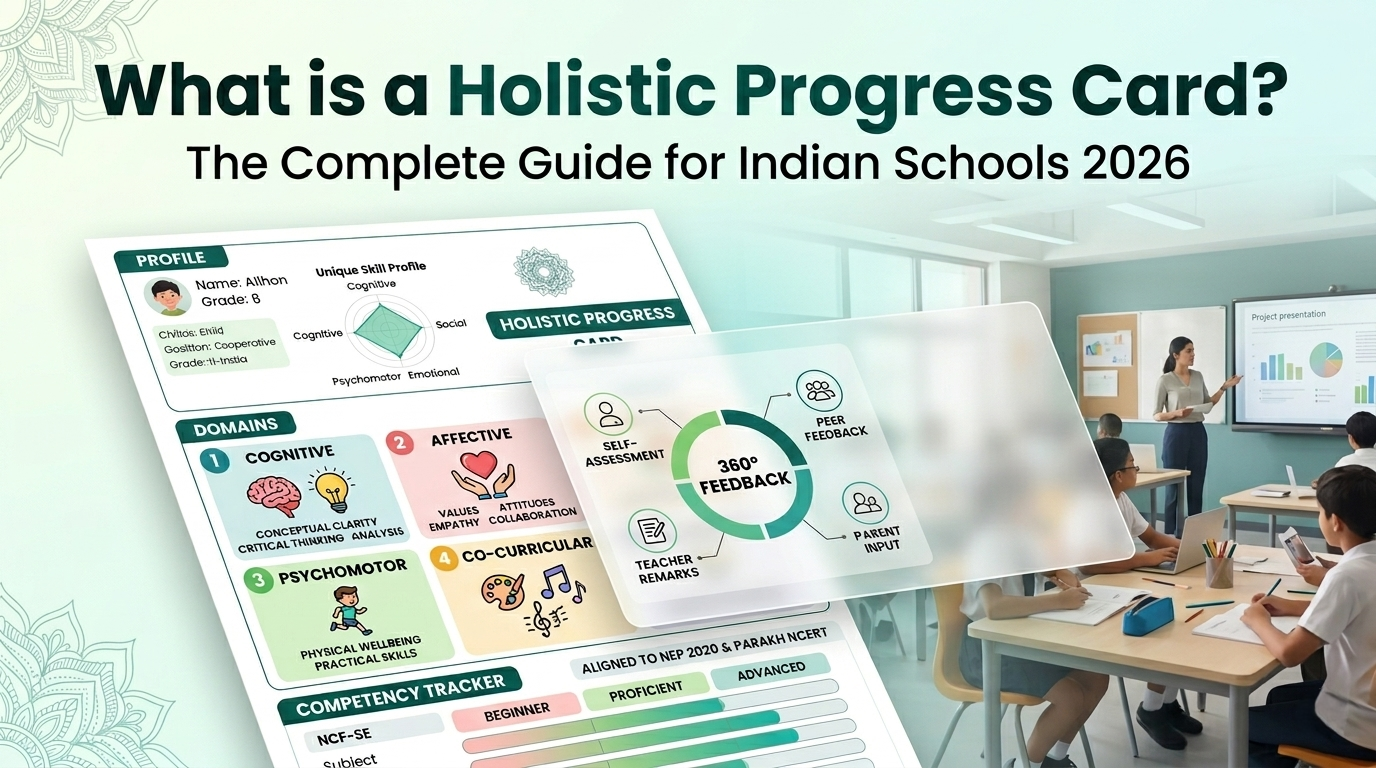
PARAKH — the National Assessment Centre established under NCERT — has been mandated to design the Holistic Progress Card (HPC) that NEP 2020 envisaged. The HPC is described on the PARAKH site as a 360-degree, competency-based progress record covering all four stages of schooling.
Two design intents matter for school leaders:
Multidimensional, not multi-page. The HPC is meant to record progress across cognitive, socio-emotional, and psychomotor domains using teacher, peer, parent, and self-reflection inputs — not simply append more sections to a marks-based report.
Competency-based, not activity-based. The point is not to list every event a child attended; it is to describe what competencies she has demonstrated through those events.
CBSE has begun rolling this out through its own HPC documentation, and several states (including Uttar Pradesh and Manipur) have started parallel efforts. The direction is settled even if the timeline varies by state.
How does a Holistic Score architecture work in practice?
The translation from policy intent to a number teachers can actually compute has been the missing piece. Reportify, a holistic student development platform incubated at the IIM Lucknow Enterprise Incubation Centre, proposes a transparent two-part architecture:
Component | Range | What it captures |
|---|---|---|
Academic Score | 0–5 | Performance across academic subjects, weighted by stage |
Co-curricular Skill Development (CSD) Score | 0–5 | Skills demonstrated through co-curricular events |
Holistic Score | 0–10 | The combined view used in the report card and dashboards |
The two halves answer different questions. The Academic Score answers "did she master the syllabus?" The CSD Score answers "what can she do beyond the textbook?" Adding them gives a single comparable number without flattening the underlying detail — sub-scores and skill profiles remain visible.
This matters because most schools already track marks well. The harder problem is converting messy co-curricular reality — Basketball, debate, science fair, NCC, mural painting, robotics — into a defensible score.
How is the CSD Score built? The five scoring dimensions
A skill is not "scored" by ticking a participation box. Reportify's CSD model uses five dimensions — drawn from how Indian school events actually vary — to score every event:
Skill Relevance — which of the 12 skill domains (Critical Thinking, Creativity, Communication, Teamwork, Problem Solving, Leadership, Social Skills, Motor Skills, Self-Discipline, Empathy, Cultural Awareness, Citizenship) does the event genuinely develop?
Participation Volume — how often the student engages, not just whether they showed up once.
Achievement — outcome at the event (participated, finalist, winner), weighted realistically rather than winner-takes-all.
Temporal Consistency — whether engagement is sustained across the academic year or front-loaded for a report.
Competition Intensity — intra-school, inter-school, district, state, or national level.
The taxonomy is deliberately Indian. The platform maps 619 co-curricular events across 6 categories and 68 sub-categories — covering everything from a classroom storytelling round to a CBSE cluster sports meet — so that school coordinators can record an event without manually deciding what skill it represents.
Can rural and budget schools demonstrate holistic development without national-level events?
This is the equity question, and it is the question that decides whether holistic assessment is a real reform or an elite-school feature.
A useful Reportify finding: a student participating in 5–6 well-designed intra-school events across different categories can reach a CSD Score of 4.5 or higher — without ever attending a national-level competition. The score depends on the design and consistency of the events, not on the school's ability to fund travel to Delhi for a Math Olympiad.
The implication for principals of low-fee and rural schools is direct. A planned annual calendar of category-spread intra-school events — debate, art, sport, civic engagement, science exploration, cultural — produces enough evidence for a defensible holistic profile. PARAKH's emphasis on system-wide equity in assessment is not contradicted by Reportify's model; it is supported by it.
Schools should treat this as indicative of what is possible with deliberate design, not as a guarantee delivered by software. The events still have to actually happen, and they have to be recorded.
Will this not overload already stretched teachers?
The honest answer: yes, if a school tries to track everything manually with paper and Excel.
NCF 2023 and PARAKH guidance both push assessment toward integration with existing classroom and co-curricular activities, not bolt-on exam-style processes. Three pragmatic moves keep teacher load bearable:
Start narrow. Pick 8–10 routine events per academic year, mapped to the 12 skill domains, before scaling.
Use simple rubrics. Two-line behaviour descriptions per skill level beat 30-point scales.
Automate the arithmetic. Teachers should be recording observations, not computing weighted averages. Schools can use the Skill Analyser at /simulator to upload a sample year's events and see an indicative CSD Score in minutes — useful both as a sanity check and as a starting point for conversations with parents.
How should schools talk to parents about a Holistic Score?
The parent conversation is often harder than the implementation. Three principles work in practice:
Position holistic as additive, not a substitute. "Marks plus skills, not marks versus skills." Board results still matter for admissions, and the academic score still appears on the report.
Show, do not tell. A skill profile across the 12 domains, with two examples of where the child demonstrated each, is more persuasive than a paragraph about NEP 2020.
Be honest about limits. A Holistic Score of 7.4 is a conversation starter — about strengths to build on and gaps to address — not a label that defines the child. Schools that frame the score this way avoid the comparison trap that ranks have always carried.
The parents page at /parents explains this in language designed for the home, useful to share at the start of an academic year.
Bringing it all together
Marks remain a real measure of one real thing: academic performance against a syllabus. They are not, and were never designed to be, a measure of student development. NEP 2020, NCF 2023, and PARAKH's Holistic Progress Card all point in the same direction — competency-based, multidimensional, equity-conscious assessment — and Indian schools now have the conceptual permission and the operational tools to make that shift without dismantling what works.
A defensible model has three traits: it keeps academics visible, it captures skills with transparent rubrics, and it works for a rural government school as well as a metro private one. A 0–10 Holistic Score that combines a 0–5 Academic Score with a 0–5 CSD Score, built on a structured event-to-skill taxonomy, meets all three.
Try the Skill Analyser with one year of your school's events. See how schools are implementing the framework on the /schools page. When you are ready, book a demo, and we will walk through your specific Holistic Score design.